Friday, June 9, 2017

DISTON, DISSTON, DREXEL of PASCO County, FL Part 3

Headland, Alabama is north of Dothan and home to nearly 5,000 residents. The town was founded in 1871 by James J. Head. The founder however relocated in 1883, settling north of Tampa in Florida’s Hillsborough County. On May 28, 1883, James J. Head was appointed Postmaster of a newly established DISTON Post Office, located on land owned at the time by a Philadelphian Capitalist and saw blade manufacturer, Hamilton DISSTON. Head is said to have named the county’s Lake Magdalene.


(Note the Pasco County map of 1888 above. DISTON, circled in orange, is shown in Hillsborough County, while circled in blue is a town called 'Seminole', which then became DISTON of Pasco County.) 

As mentioned in Part two of this series, Savannah, Florida & Western Railroad was hoping to extend rail service from Ocala south to Tampa Bay. The railroad, among others making plans for service on the Gulf Coast, would improve travel for those desiring to buy Disston properties in west central Florida, including his coastal town of Tarpon Springs.

What all DISSTON planned for Hillsborough County is unclear, but whatever his plan for the lakeside town of DISTON quickly vanished! James J. Head relocated again, and on January 20, 1888, he was again appointed a postmaster, this time for a Pasco County Post Office – a post office also named DISTON.

A likely explanation would be a shift of county lines, but that was not so in the case of Pasco County’s DISTON. Still misspelled, this new post office had definitely moved, a distance of nearly 10 miles. DISTON of 1888 Pasco County was also located on a lake, the north side of Thomas Lake – as opposed to the 1883 location at Lake Magdalene.

Why the move? The intended line of Savannah, Florida & Western Railroad, that proposed train to connect with Tampa, never happened! A train from Ocala eventually arrived at Tampa, but its alignment bypassed DISTON to the east.

Moving DISTON to Pasco County made perfect sense – as this stop would be on the new Orange Belt Railway line, a train providing connecting service from Sanford on Lake 
Monroe to DISSTON’S Gulf Coast development at Tarpon Springs.

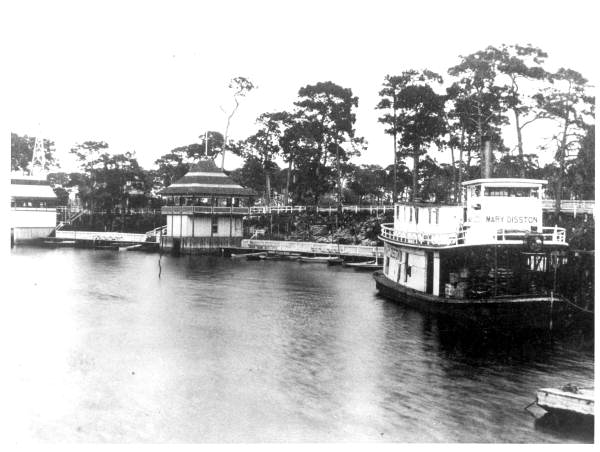
The Mary Disston steamboat docked at Tarpon Springs, Florida

Wednesday, June 21, 2017, Part Four of DISTON, DISSTON, DREXEL, Our search for a PASCO County Ghost Town, will pick up right here, at Doctor James J. Head’s new residence and Post office, not in Hillsborough County, but rather Pasco County, Florida.  

Wednesday, May 31, 2017

DISTON, DISSTON, DREXEL of PASCO County, FL Part 2

In search of a PASCO County Ghost Town - Part 2

Florida’s first railroad began service before the Civil War. Called the Sea-to-Sea Railway, the train ran from the Atlantic Coast to Cedar Key on the Gulf of Mexico. As late as the 1880s though, Coastal areas south of Cedar Key, including Tampa Bay, were not easily accessible. Transportation was critical to further development, and nobody knew that better than Hamilton DISSTON, the Capitalist from Philadelphia who had bailed Florida out of debt. Owner of 4 million acres of central Florida land stretching from the Atlantic to the Gulf of Mexico, he needed railroads if his investment was to pay off.

Various plans for railway routes were in the works by 1883, but until ideas transformed into real train service, developers decided to use the old 155 mile train that ran between Jacksonville and Cedar Key. At Cedar Key, passengers and freight then transferred onto a steamship to continue a journey south to the new coastal towns of Port Richey, Tarpon Springs (Part 1) and beyond.

In 1884, steamers ‘Governor SAFFORD’ and ‘California’ began “Plying between Cedar Keys and DISSTON on the West Coast of Florida,” delivering settlers and supplies, then returning north with fresh oranges for markets up north. Railroad builders meanwhile were racing to lay down track in the direction of Tampa Bay on the west coast.

Peninsular Railroad sought approval to extend their existing ‘Waldo to Ocala’ route even further south to Tampa. South Florida Rail Road had extended rail service to Kissimmee, but the Gulf Coast region of the State still eagerly awaiting their planned service to Tampa. A third railroad, Savannah, Florida & Western Railway, planned to lay down track along the western coast. An 1884 brochure, bragging of ‘Florida and the famous Tarpon Springs, the new Health Resort,’ was a DISSTON sales brochure showing all three proposed routes.


The Tarpon Springs Hotel, Source, Library of Congress

Both Peninsular Railroad and Savannah, Florida & Western Railway, as shown in the DISSTON sales brochure, were to cross land in Hillsborough owned by Hamilton Disston. One was to pass alongside present day Lake Magadelene, by the brochure failed to say when that particular service might be available.


Routes of Railroads heading toward 1883 Tampa 


Meanwhile, in far off Headland, Alabama, a historical marker today provides a clue as to what happened next down in Florida’s Hillsborough County. “Headland, founded in 1871 as ‘Head’s Land’ by James Joshua HEAD (1839-1927). He platted the town and built his home.” The plague goes on to explain, “J. J. HEAD moved to Tampa, Florida in 1883, and established Lake Magdalene.”

An Alabama town founder moved to Florida, where on May 28, 1883, he was appointed Postmaster for the DISTON Post Office. A Hillsborough County map of 1888 shows DISTON, spelled incorrectly in both postal archives and on that map, as being located in Section 2 of Township 27 South; 19 East. The entire 640 acre Section 2, where the DISTON Post Office was shown to exist, had been deeded 18 months earlier, October 6, 
1881, to Mr. Hamilton Disston of Philadelphia.


Friday, June 9, 2017, Part Three of DISTON, DISSTON, DREXEL, Our search for a PASCO County Ghost Town, picks back up right here, at Doctor James J. Head’s residence and Post office in Hillsborough County, Florida. 

Thursday, May 25, 2017

DISTON, DISSTON, DREXEL of PASCO County, FL - Part 1

PART ONE: In search of a PASCO County Ghost Town. 

DISTON started out as a Post Office in 1883, but was located in Hillsborough County. By 1888, this Post Office had relocated to Pasco County, but the County line in this region had not changed. Then, within only a few months, the name DISTON changed to DREXEL on September 15, 1888. At that time the post office was a stop on the Orange Belt Railway, a train running between Sanford and St. Petersburg. So, what’s the story of Diston, said by early researchers to have been misspelled - meant to be DISSTON, and why the change to Drexel?

To fully appreciate this fascinating story we must begin with a Hernando County farmer named Aaron M. RICHEY. Homesteading in the early 1880s, Aaron RICHEY farmed 80 acres alongside land belonging to the ex-Governor of Arizona, Anson P. K. SAFFORD. 

In late 1884, RICHEY & SAFFORD laid out a new Gulf Coast town they named Port RICHEY. That November year, the Steamboat ‘Governor SAFFORD’, owned by Florida Railway & Navigation Company, made its inaugural run hauling freight and passengers between Port RICHEY and Cedar Key.


Steamer 'Governor Safford' began service November, 1884

In addition to operating a schooner, Aaron RITCHEY planted orange trees, and his were said to be “as large as many of the trees in other parts of the State.” By 1885, the area around Port RICHEY, said Webb's Historical of that year, had "a great many trees from six to ten years old that are loaded with oranges." 

Settlers buying at Port RICHEY were, “almost without exception, raising orange groves.”


Following his stint as Arizona Governor, SAFFORD had occasionally journeyed to New York and Philadelphia on business. While visiting Philadelphia, SAFFORD learned of the four million acre Florida land acquisition by Hamilton Disston, and so SAFFORD came to Florida as one of Disston’s land agents. 


Arizona Governor Anson P. K. SAFFORD

Anson SAFFORD and Aaron RICHEY developed land north of the Pithlachescotee River, the location of their new town, while Disston Land Company owned the acreage on the south side of that river, land fronting as well on the Gulf of Mexico. 

Disston Land Company also owned land further south, also along the coast, where yet another new town was about to be developed, TARPON SPRINGS, which is exactly where Part Two picks up next Wednesday, May 31, 2017.

IN SEARCH OF A PASCO COUNTY GHOST TOWN
SPONSORED BY www.CroninBooks..com
CitrusLAND: Ghost Towns & Phantom Trains


Much, much more to come as this series works its way inland!

Thursday, April 27, 2017

CASSADAGA of Volusia County

Unraveling the Mysterious Origin of CASSADAGA

The usual account as to how Volusia County’s Spiritualist camp got its start is that it was founded in 1894 by George P. Colby. This is true, but the rest of an intriguing story as to how CASSADAGA, a unique sort of CitrusLAND Ghost Town, came to be wouldn’t be complete without mention as well of a fellow named Luther Colby, the legendary Amelia Colby Luther, and a lake in western New York named Lake CASSADAGA.


 “What I saw at CASSADAGA Lake, 1888,” was authored by a Pennsylvania Attorney, writing of experiences not at Florida’s CASSADAGA Spiritualist Camp on Volusia County’s Colby Lake, rather at CASSADAGA Spiritualist camp of New York.

Two CASSADAGA camps, one in Florida and the other in New York, share a history of Spiritualism dating to the 19th century. Both camps share as well a family’s history, that of the #Colby family.

CASSADAGA Lake Free Association of New York was established August 26, 1879. Minutes of the organization reflect that a Mrs. Amelia H. Colby was asked to name the association, and so she selected the name CASSADAGA. The State charter says the association was founded for “literary and scientific purposes and mutual improvement in religious knowledge.”

Located beside New York’s Lake CASSADAGA, southwest of Buffalo, in Chautauqua County, the camp was six miles east of LAONA, home to a forerunner organization that led to the CASSADAGA movement. History records a ‘Trace Medium’ was a resident of LAONA, NY as early as 1853.

Holland, NY is northwest of CASSADAGA and the birthplace, in 1829, of Amelia Hunt. At Age 20 at Holland, Amelia married Hylon COLBY. Two years later the couple moved west, and by 1870, Amelia H. Colby was living in Indiana, a mother of three teenagers and already promoting herself as a Spiritualist Lecturer.

The Omaha Daily Bee reported on March 2, 1875 that Amelia’s appearance at Meyer’s Hall was so crowded she agreed to deliver four additional lectures. Mrs. Amelia Colby was also a guest speaker at the 1880 Freethinkers of the United States convention. Held at Hornellsville, NY, the 1880 gathering was covered by “Banner of Light,” a prominent Spiritualism publication of which Luther Colby of Massachusetts had served as Editor since the paper’s founding in 1857.

Interest in Spiritualism was spreading throughout the north in the 1880s, and new meeting camps were popping up in nearly every state. Amelia continued traveling the countryside lecturing, but she also remarried in 1887. Her second husband was James H. Luther of Crown Point, Indiana. Now Mrs. Amelia H. Colby Luther, she and her husband became members, in 1888, of the Indiana Association of Spiritualists, and both were instrumental in the founding of Camp Chesterfield.

Meanwhile, the essay by that Pennsylvania lawyer, “What I saw at CASSADAGA, 1888,” was published in 1889 by Colby & Rich Book Publishers of Boston, MA. The Colby of this publishing company was the same Luther Colby that was Editor of the Banner of Light newspaper.

And so by 1890, CASSADAGA of New York had come into its own as a Spiritualist camp, due in large part by both Mrs. Amelia Colby Luther of Indiana and Luther Colby of Massachusetts. Another traveling Spiritualist however had visited Florida prior by 1890. Palatka Daily News of January 4, 1888 reported: “George P. Colby to Lecture on Spiritualism at Fry’s Opera House.”

George P. Colby was also invited to address the New York CASSADAGA assembly of 1894, speaking there two years after Susan B. Anthony and Clara B. Colby, two prominent woman suffragists of that time, had addressed the 1892 gathering.
Four Colby’s had been involved with CASSADAGA of New York by 1894, the same year George P. Colby sliced off a corner of his 150 Volusia County acres for a ‘Spiritualist Meeting-Camp.’


Touring central Florida in 1895, Amos Root, author of ‘Gleanings in Bee Culture’, told of attending a ‘Lake Helen camp-meeting’ at Volusia County. Root expressed skepticism after visiting the camp, remarks in sharp contrast to the Pennsylvania Attorney, Anson R. RICHMOND who had argued in his “What I saw at CASSADAGA Lake, 1888” essay trying to disprove allegations the New York camp was a fraud.

ROOT and RICHMOND of course epitomize the widely conflicting views by the public, both then and now, on what occurs at Spiritualist camps. Leaving from DeLand, FL in 1895, then the closest railroad station to the Volusia County Spiritualist camp, Amos ROOT described his experience; writing that he had employed “a livery man to take me the five or six miles. The driver and I naturally discussed this camp-meeting, as he had attended one or two. Once a week they held a “séance,” if that is the right name for it, where the spirits not only wrote on slates, played on instruments, operated telegraphic machines, etc., but the faces of the dead appeared to the audience, and the departed ones conversed with their friends, shook hands, etc. The admission fee was $1.00.”

“The speaker’s stand was spanned by a beautiful arch on which was the text, ‘Peace on earth, good will toward men.’ The hymns that were sung were such as we generally use in our places of worship. The music was most beautiful. A bright young daughter of my friend played the violin, and another bee-keeper’s daughter played the guitar.”
Root was not himself convinced by the visit, yet told of one woman who said; “she saw the face of her mother, who died years ago, as plainly as she saw my face, and talked with her.” Amos said he could not “understand how the things were done, and that he never “weighed individuals and studied faces as he did then.”

CASSADAGA of Volusia County today sits along the western shore of Lake Colby, a short distance from Giddings Lake, named for Theodore D. Giddings, an 1880s homesteader who came south from Wisconsin with George P. Colby. Both mediums, both had relocated to CitrusLAND, America’s 19th century Paradise.

Luther Colby died October 7, 1894 at Boston. Mrs. Amelia H. Colby Luther died December 26, 1897, or so the administrator of her estate swore to upon oath. Despite a grave marker verifying court records, Eli Wilmot Sprague described a July 29, 1904 camp meeting at Chesterfield, Indiana: “Mrs. Amelia Colby-Luther occupied the platform in the morning giving one of her masterly discourses.” Two days later, the following was stated; “Sister Luther, I am happy to clasp hands with you from across the borderland.”
As for CASSADAGA of Volusia County, George P. Colby remained active until his death in 1933.


References furnished upon request to Rick@CroninBooks.com

A Goodreads #MysteryWeek Special Edition of Rick’s Blog

A Ghost Town needn’t be a place of paranormal activity. It can also be a mysterious once-upon-a-time town long since vanished. Central Florida of the 19th century had many such locations, a vague recollection identifying a once planned town that failed to survive. Instead, today a place name merely hints at that one-time location. Lakeville Road in West Orange County is one prime example, for other than the street’s name, there is no indication today that the once planned town of Lakeville existed.

Mystery and History – get all the details, and view each book at www.croninbooks.com


Recently released Novel: IN HIS BROTHER'S MEMORY 

Thursday, April 6, 2017

CRESTON of West ORANGE COUNTY, Florida


A 240 acre Town Plat of CRESTON was recorded with Orange County’s Clerk of Court on the 1st day of April, 1887. Now a Ghost Town, Creston of the 19th Century was intended to be a key railroad hub. Situated on the east side of Johns Lake, bordering also the north shore of Black Lake, the new city’s intended role was to play a role in opening up West Orange County for development, a plan evidenced by an abundance of historical documents including the town’s name itself.

1890 Town of CRESTON, Florida, at center of map above

Central Florida’s legendary James G. SPEER filed his plat of Oakland after Creston had been filed. Oakland was recorded July 12, 1887, 103 days after Creston, making Creston the earliest planned official town of West Orange County. Plats indicate Oakland as being larger, but each town shared one attention-grabbing feature – a railroad. Two different railroads at that!

The primary distinction between Speer’s Oakland and Town of Creston was that Oakland had an operating train. Orange Belt Railway had begun service from Sanford on Lake Monroe south to Speer’s Oakland in late fall 1886. The planned railroad for Creston however never happened.

Still, despite Creston planners failing to establish a successful town, their 1887 plat tells wonders about one long-forgotten Chapter in West Orange County’s intriguing history. Dates truly matter when tracking history. Consider Creston, founded in 1887. The town plat shows an intriguing alignment for a planned railroad, and even names the railroad. The letters TA&GRR (see circled letters on Plat). The abbreviated letters are for ‘Tavares, Apopka & Gulf Railroad,’ but that train, at that place and at that time, challenges that was known about this region’s history.

To appreciate the significance, we must first differentiate between TO&A, TA&G and T&G. All three call letters identify trains. The ‘Tavares, Orlando & Atlantic Railroad (TO&A)’, operated between Tavares and Orlando, but north of Lake Apopka; Tavares, Apopka & Gulf Railroad (TA&GRR), operated along the west side of Lake Apopka, from Tavares south to Montverde, where it was intended to veer westward to Clermont, and ultimately continue west to the Gulf of Mexico. After going into foreclosure in 1890, the TA&GRR reemerged a year later as Tavares & Gulf Railroad (T&G). The revived T&G did enter Orange County, but didn’t reach Oakland until 1891, Winter Garden in 1899, and finally Ocoee by 1914.

1887 Plat of Town of CRESTON, Orange County, Florida

The 1887 plat of Creston however shows the original TA& GRR as planning a stop southeast of Oakland four years before the revived T&G railway finally arrived at Oakland. Why does this matter? The Creston Plat establishes that planners had switched directions for the TA&GRR long before the railway filed for foreclosure in 1890.


Prior to 1880, Central Florida growth had been lethargic. Transportation, or the lack thereof, was the principal reason for lackluster growth throughout the region. A decade earlier, creditors had obtained an injunction preventing the State from issuing public lands to entice building railroads. Typically, land was the reward to investors willing to foot the bill to lay down track. But Florida’s Post-Civil War debt had yet to be paid off, and the court injunction because of that unpaid debt hindered would-be railroad builders. Enter Henry Disston, the man who saved the day!

Disston changed everything in 1881 by depositing with the State his first installment on a pledge to acquire 4,000,000 acres of public land, money used to eliminate Florida’s debt. Much of the acreage was in South Orange County, land that became Osceola County May 12, 1887. More than paying off debt though, Disston had big plans for Osceola County, and he needed railroads to deliver customers interested in buying his lands.

Florida Midland Railway originally intended to operate between Lake Jesup and Leesburg, but the east-west railroad abruptly turned south, passing through Ocoee and Gotha on its way to Disston’s new town of Kissimmee. South Florida Railroad had already extended its service from Orlando to Kissimmee in 1882.

In West Orange County, Orange Belt Railway was well ahead of TA&GRR in laying down track toward the Gulf of Mexico. Palatka Daily News, May 28, 1887, wrote: “The Orange Belt Railroad is displaying wonderful activity. 1,800 men are at work along the line between Oakland and Pinellas.” Orange Belt Railway squeezed out the Tavares competition at Clermont, requiring an immediate change in direction of the TA&GRR if it hoped to survive.

Tavares founders believed their city provided a better alternative to the combination steamboat and train through Sanford. Planned as a hub for multiple land based railroads, Tavares offered a direct land route to Jacksonville. The TA&GRR had arrived at the doorstep of Orange County when it found it could not continue westward, so a change of direction was needed. Now enter the New Hampshire Attorney, Harry BINGHAM.

Bingham bought 1,756 acres south of present day Winter Garden, with the first acquisition occurring October 30, 1882. In rapid succession, other investors began buying land surrounding Bingham’s property: Anthony H. SEIPT, President of Perkiomon Railroad of Pennsylvania, purchased 5,336 acres, and Charles H. Morse of Winter Park, acting as Trustee for himself and partners Franklin Fairbanks and Francis B. Knowles, bought up 9,901 acres.

By mid-1883, an enormous swath of West Orange County, 17,000 acres in all, belonged to five (5) Northerners. Oakland and Winter Garden did not yet exist as towns. Another land sale the same year, finalized October 5, 1883, conveyed 120 acres to an individual identified only as F. A. RUSH.


Fannie A. RUSH, wife of Dr. Warren B. RUSH, had acquired the first of several parcels, land that would exceed 500 acres by 1884. Warren & Fannie RUSH then sold 40 acres March 25, 1886 to Margaret A. BLACK of Scotland, a parcel that was adjacent to 40 acres acquired by George BLACK, land that today would be adjacent to Black Lake.

Five (5) months after recording their plat, Dr. Warren & Fannie RUSH closed on the first town lot sale. The date was August 27, 1887, and B. N. ZERKLE was the buyer of “Lots 90 & 94 in Block B of Town of Creston.”

Dr. RUSH and wife Fannie came to Orange County from Sidney, Iowa, arriving around the same time as their 1883 land acquisitions. Residents of Sidney in 1880, their life on the prairielands had changed abruptly.

Outlaws Wells & Norris robbed nearby Davis & Sexton Bank in Riverton in 1881, using horses stolen from Sidney. After capture, both bandits were returned to Sidney. Though the desperados had been caught, the RUSH family residence was amid the turmoil of the wild, wild-west. And so Dr. Warren & Fannie (ASHER) RUSH moved to Central Florida, and along with them came John A. ASHER.

The RUSH clan likely departed Iowa aboard the Chicago, Burlington & Quincy Railroad, and no doubt had a layover at a town established by the CB&Q – a site selected for a hub by the railroad because of its location - a “division point, on a crest of land between the basins of the Mississippi and Missouri rivers. By the 180os”’, says Amtrak Station Facts, “the town of CRESTON, Iowa had become a major rail hub.”

Acreage selected by Warren B. & Fannie A. RUSH, and the adjacent parcels acquired by John A. ASHER, were strategically located as well, midway between TAVARES and KISSIMMEE City, the perfect location for CRESTON, Florida.

1890 Lake County Map showing TA&GRR in Orange County

An 1890 Lake County map shows the (TA&GRR) as entering Orange County west of Oakland, (even though this line was not built), and then veering south along the west side of Butler Chain of Lakes, terminating at Kissimmee City. Had Creston materialized, West Orange County would have developed very differently, but like many a 19th century CitrusLAND planned town, it is today a Ghost Town.

Research for the Town of Creston was donated in 2015 by this author to:

WINTER GARDEN HERITAGE FOUNDATION


Visit www.CroninBooks.com and peruse: The Rutland Mule Matter; CitrusLAND; Ghost Towns & Phantom Trains; First Road to Orlando; CitrusLAND: Curse of Florida’s Paradise; and CitrusLAND: Altamonte Springs of Florida. Books are available at WINTER GARDEN HERITAGE FOUNDATION, Bookmarkit stores in Orlando; Amazon.com and directly from the Author by emailing: Rick@CroninBooks.com

Wednesday, March 22, 2017

TORONTO of Orange County, Florida

For a brief moment in Orange County’s remarkable history, Alice C. (FORBES) HILL, a native of Georgia, envisioned a town of 120 acres at the crossroads of ORANGE BELT RAILWAY and TAVARES, ORLANDO & ATLANTIC (TO&A) lines. Alice planned her 1887 town of TORONTO to be a vital CitrusLAND transportation hub. She planned a UNION DEPOT, at her intersection of Toronto Avenue and Orange Belt Avenue, where passengers and freight could be transferred for all points within Florida and beyond.

Present day view looking northwest of Ghost Town Toronto

TO&A President William R. ANNO, in 1883, reported his railroad would soon offer “Palace Sleeping Cars” at no additional cost to its customers, and said he planned to offer rail service, “from the Atlantic at TITUSVILLE northwest to TAVARES, through Orange County, to connect with the trunk lines north in the State. His railroad only managed to connect Tavares with Orlando prior to falling into foreclosure.

Of 250 planned Town of Toronto lots only one sale was ever recorded. Trigg Frugate & Company, an Abington, VA lumber dealer, purchased a full block for use as a rail siding.
Today, much of the once-upon-a-time town of TORONTO serves as a storage yard for a prefab concrete facility. The existing track in the photo is that or the original Tavares, Orlando & Atlantic Railroad looking northwest toward Apopka. Remnants of Orange Belt Railway track bed lead off on the left in the direction of Lakeville, Clarcona and eventually Winter Garden. Union Depot, had it been built, would have been located at this very location.

Toronto of Orange County, Florida, and the two railroads serving this 19th century town, are featured on pages 100-104 of CitrusLAND: Ghost Towns & Phantom Trains.

America’s central Florida Paradise disintegrated over the winter of 1894-95! A great freeze that season destroyed not only the State’s record-setting orange crop, but wiped out as well the ambitious dreams of not only the locals, but many of the wealthiest individuals in the world. Their true-life stories are told as you journey aboard ORANGE BELT RAILWAY with two of America’s renowned railroaders.

All aboard!

Racing along at a top speed of nearly 6 mph, meet the men and women, dreamers who risked everything during the 1880’s to develop the remote wilderness along Orange County’s western corridor. With stops at Sylvan Lake; Paola; Island Lake; Glen Ethel; Palm Springs; Forest City; Toronto; Lakeville; Clarcona; Crown Point; Winter Garden and Oakland, you will experience first-hand a history of this region never before told. “Multitudes,” said 1880s resident Benjamin M. Robinson of the horrible freeze, “abandoned their groves and homes, in some cases leaving tables set and beds unmade, and went away.” CitrusLAND: Ghost Towns & Phantom Trains.

AVAILABLE AT AMAZON.COM
CLICK ON BOOK COVER TO VISIT AMAZON PAGE
Visit my website, www.CroninBooks.com for more of central Florida's fascinating story 

Monday, January 2, 2017

RUNNYMEDE of Osceola County, Florida

Lifted from pages of a 19th century pamphlet: “Let it be understood at the outset that this is no visionary or ‘wild cat’ speculation. The town is already started, backed by capitalists who intend to make it a success.” While these words could describe intentions of a hundred or more Central Florida towns of the 1880s, these were taken from pages of a brochure preserved by the Library of Congress, a brochure prepared for the marketing a new CitrusLAND city named RUNNYMEDE.

The Runnymede Hotel

Printed to attract potential buyers, the Runnymede prospectus described a town that was to encompass 3,000 acres and sit along the south shore of East Lake Tohopekaliga. Runnymede was 12 miles south of then KISSIMMEE CITY, a town which only four years earlier, said the pamphlet of Kissimmee, “there was not a sign of a town; now it has over 1,600 inhabitants, 600 buildings, including several hotels.”

Runnymede, so the prospectus explained, was named for the historic birthplace of the MAGNA CHARTA on the banks of Thames River, where King John signed, on June 5, 1215, the historic document, “viewed by the ages as the basis of all English liberties.”

Runnymede, Florida brochure
Source: Library of Congress

Philadelphian businessman Hamilton Disston had reenergized interest in Orange County during 1881 with his first installment to the State of Florida on 4,000,000 Florida acres. Disston’s purchase paid off the State’s debt, which had hampered further development in the 27th State. News of a debt free Florida spread quickly, not only throughout the Nation, but overseas as well.  English investors flocked to Central Florida, buying up huge chunks of wilderness land.

South Florida Railroad Company then extended rail service from Orlando further south, reaching Kissimmee City in 1882. Rail service was the first major step in opening up Hamilton Disston’s vast new development. President Chester A. Arthur visited Central Florida the following year, a rail journey that arrived at Kissimmee in April of 1883.

An early reference to Runnymede of Central Florida appears in a letter postmarked at NARCOOSEE, Florida. Dated November 2, 1885, a native of England, newlywed Helen (Heig) Warner wrote home to her mother, saying: “We are thinking of going to Runnymede in a month or so. Mr. Watson has offered Bill (William R. Warner) a very good job.” Helen described the distance between Narcoosee and Runnymede as being two (2) miles.

Part of Orange County at the time of the town’s formation, the Runnymede brochure included a note stating that a bill had already been introduced at Tallahassee to form a separate county, “the County of Osceola, named for the celebrated Seminole Chief.” Osceola County, Florida was officially established May 12, 1887.

Plans for Town of Runnymede were beginning to come together for English investors, the very “capitalists intending to make the new city a success,” and to improve chances even further, these foreigners recruited a District of Columbia government employee to oversee the Florida venture.

Harry F. Smith, a 21 year veteran of the U. S. Land Office at Washington, D C, came on board to manage Runnymede affairs from his office at our Nation’s Capital. If the name Harry F. Smith sounds familiar, it’s because the man was also associated with another Ghost Town Post of mine, SENECA of Lake County.

Commenting on his own background in the Runnymede sales brochure, Harry Smith reported that during his tenure in Washington, “nearly every foot of land disposed of in the Southern states has been under my supervision.” So when the 1887 Runnymede brochure was sent to the printer, Harry F. Smith was already on board, and a vision for a new town on East Lake Tohopekaliga’s south lake shore was taking shape.

Fashioned after Smith’s hometown of Washington, D. C., a Runnymede street plan was established having roads, “running east and west named after the letters of the alphabet, while avenues running north and south, except the one along the Lake shore, named after the States.” Pennsylvania Avenue, much like that of Pennsylvania Avenue in our Nation’s Capital, was to be 100 feet wide and serve as “the main or principal” avenue.

What brought down a Central Florida town named for the birthplace of the Magna Charta? Helen Warner’s letters provide the answer. “There is a scare of yellow fever just now, we are in quarantine.” Helen wrote these words to her mother 18 June, 1887, and while the fever itself had not reached Orlando or Kissimmee, mere mention of the fever made the entire State guilty by association. The fever scared off land buyers. Headlines around the globe declared: “Yellow Fever in Florida,” and stories of the fever in Florida were not short lived. A Montana newspaper article of November 15, 1887 reported: “Surgeon General Hamilton has received a letter from Tampa, Florida, saying that there were three new cases of yellow fever yesterday.”

Money and political clout would have been helpful in selling town lots, but neither were capable of calming fears of potential buyers. A dream of a Runnymede faded, and over time, a city of St. Cloud emerged nearby, naming its avenues running north and south, except the one along the Lake shore, after States.

Click here to view CITRUSLAND: GHOST TOWNS & PHANTOM TRAINS book, a Five )5) Star rated historical novel based on yet another tragic 19th central Florida event – the Great Freeze of 1894-95.


Runnymede References are available by request, email Rick@CroninBooks.com